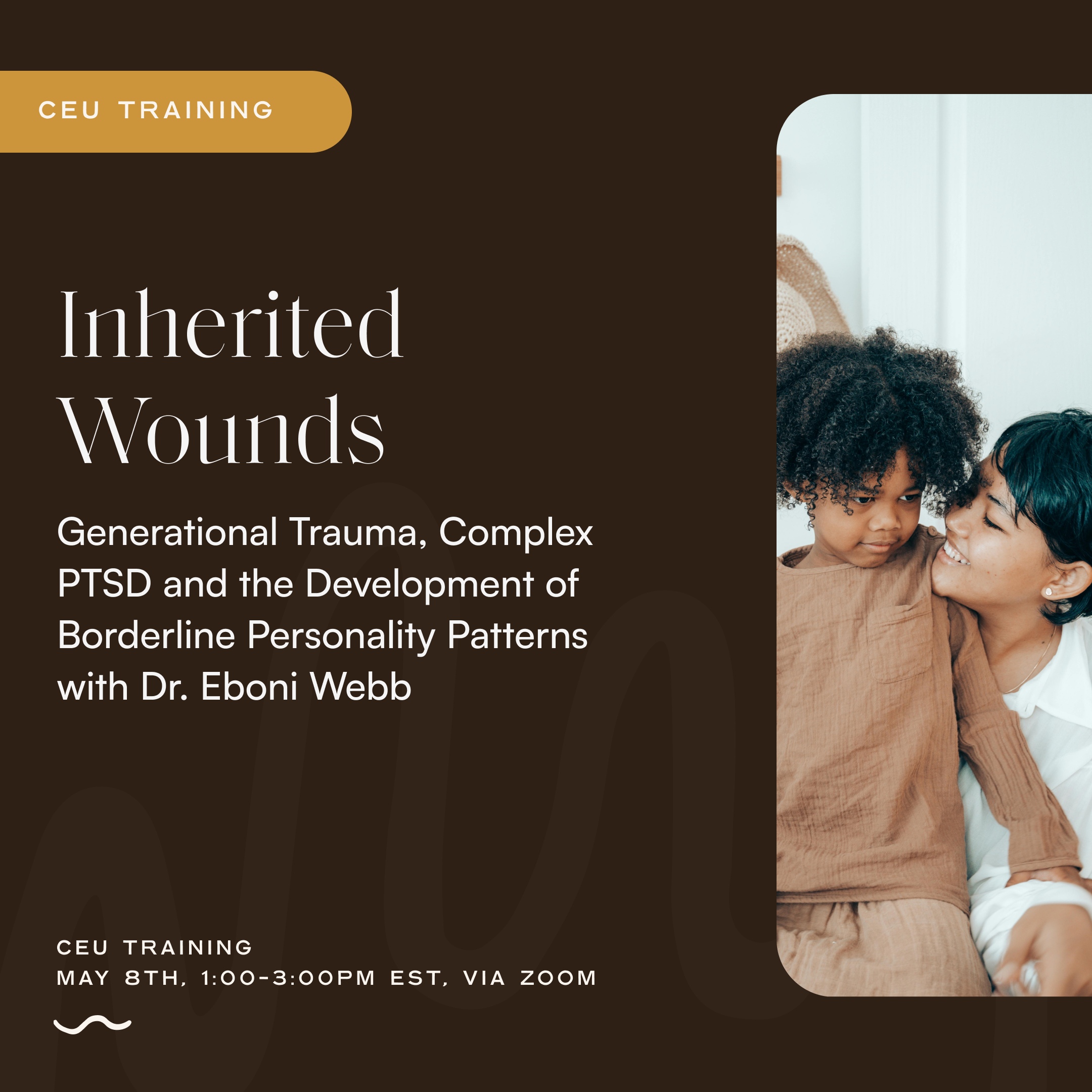
Inherited Wounds: Generational Trauma, Complex PTSD and the Development of Borderline Personality Patterns

from $89.00

May 8th 1:00-3:00pm EST, conducted online via Zoom

This training offers a trauma-informed, culturally responsive reexamination of Borderline Personality Disorder (BPD) through the lens of generational trauma and complex posttraumatic stress. Rather than locating personality pathology solely within the individual, the course situates emotional dysregulation, relational instability, and identity disturbance within inherited patterns of attachment disruption, chronic invalidation, and systemic stress. Participants will explore how historical trauma, racism, marginalization, and identity-based invalidation shape nervous system development and relational survival strategies across generations—often manifesting clinically as complex PTSD and borderline personality patterns. Particular attention is given to how BIPOC and LGBTQ clients are disproportionately misdiagnosed, under-contextualized, or pathologized when sociocultural and intergenerational factors are overlooked. Grounded in contemporary trauma research, attachment theory, and DBT-informed practice, this training emphasizes diagnostic humility, anti-pathologizing frameworks, and practical clinical interventions. Clinicians will leave with tools to more accurately assess, conceptualize, and treat high-conflict and high-distress presentations while reducing stigma, improving therapeutic alliance, and supporting sustainable, ethical care.

Participants will gain:

  • A non-pathologizing framework for understanding BPD symptoms as adaptive responses to prolonged relational threat Increased awareness of racial, gender, and sexuality-based diagnostic bias in personality disorder assessment.

  • Practical strategies for integrating generational trauma, attachment repair, and nervous system regulation into DBT-informed treatment

  • Tools for addressing clinician countertransference and reducing adversarial dynamics in high-intensity clinical work

  • Greater confidence in supporting BIPOC and LGBTQ clients with complex trauma histories while maintaining clinical boundaries and sustainability

Learning Objectives:

  • Describe how generational trauma and chronic relational stress contribute to the development of complex PTSD and borderline personality patterns.

  • Differentiate Borderline Personality Disorder from trauma-based adaptations, particularly in clients with histories of systemic oppression, identity-based invalidation, and intergenerational harm.

  • Apply DBT-informed, culturally responsive clinical strategies that address emotional dysregulation and relational instability without reinforcing stigma or clinician burnout.

Cultivating Healers seeks to provide educational and engaging CEUs with liberatory information, pop-quizzes, and case studies to ensure your learning.

This training is eligible for 2 Continuing Education Credits for NBCC Counselors & NY LMHCs, LCSWs, and LMSWs. Cultivating Healers is approved by the American Psychological Association (APA) to sponsor continuing education for psychologists.

Rate Type:

May 8th 1:00-3:00pm EST, conducted online via Zoom

This training offers a trauma-informed, culturally responsive reexamination of Borderline Personality Disorder (BPD) through the lens of generational trauma and complex posttraumatic stress. Rather than locating personality pathology solely within the individual, the course situates emotional dysregulation, relational instability, and identity disturbance within inherited patterns of attachment disruption, chronic invalidation, and systemic stress. Participants will explore how historical trauma, racism, marginalization, and identity-based invalidation shape nervous system development and relational survival strategies across generations—often manifesting clinically as complex PTSD and borderline personality patterns. Particular attention is given to how BIPOC and LGBTQ clients are disproportionately misdiagnosed, under-contextualized, or pathologized when sociocultural and intergenerational factors are overlooked. Grounded in contemporary trauma research, attachment theory, and DBT-informed practice, this training emphasizes diagnostic humility, anti-pathologizing frameworks, and practical clinical interventions. Clinicians will leave with tools to more accurately assess, conceptualize, and treat high-conflict and high-distress presentations while reducing stigma, improving therapeutic alliance, and supporting sustainable, ethical care.

Participants will gain:

  • A non-pathologizing framework for understanding BPD symptoms as adaptive responses to prolonged relational threat Increased awareness of racial, gender, and sexuality-based diagnostic bias in personality disorder assessment.

  • Practical strategies for integrating generational trauma, attachment repair, and nervous system regulation into DBT-informed treatment

  • Tools for addressing clinician countertransference and reducing adversarial dynamics in high-intensity clinical work

  • Greater confidence in supporting BIPOC and LGBTQ clients with complex trauma histories while maintaining clinical boundaries and sustainability

Learning Objectives:

  • Describe how generational trauma and chronic relational stress contribute to the development of complex PTSD and borderline personality patterns.

  • Differentiate Borderline Personality Disorder from trauma-based adaptations, particularly in clients with histories of systemic oppression, identity-based invalidation, and intergenerational harm.

  • Apply DBT-informed, culturally responsive clinical strategies that address emotional dysregulation and relational instability without reinforcing stigma or clinician burnout.

Cultivating Healers seeks to provide educational and engaging CEUs with liberatory information, pop-quizzes, and case studies to ensure your learning.

This training is eligible for 2 Continuing Education Credits for NBCC Counselors & NY LMHCs, LCSWs, and LMSWs. Cultivating Healers is approved by the American Psychological Association (APA) to sponsor continuing education for psychologists.

  • Eboni Webb, PsyD, HSP earned her Doctorate in Clinical Psychology from the Minnesota School of Professional Psychology (MSPP). She began her clinical work as assistant clinical director and program director at Mental Health Systems, PC (MHS), one of the largest providers of Dialectical Behavior Therapy (DBT) in the United States.

    At MHS, Dr. Webb developed two specialized DBT treatment programs for clients with developmental disabilities and borderline-intellectual functioning. She is comprehensively certified in DBT (PESI/Evergreen Institute and Michael Maslar of Northwestern University), MBSR, and is an advanced certified practitioner in Sensorimotor Psychotherapy. Dr. Webb is a highly rated international trainer in DBT and is a certified trainer of DBT through the Evergreen Certification Institute and PESI. Dr. Webb trains clinicians for continuing education through various companies that include PESI, Jack Hirose and Associates, and Lane Pederson and Associates.

    In 2010, Dr. Webb opened the private practice Kairos in Middle Tennessee. Kairos, now The Village of Kairos, offers diverse DBT specializations, including DBT for trauma-based disorders and co-occurring disorders. The Village of Kairos has expanded therapy programs, better known as Restorative Services, to include individual and group therapy sessions for adolescents, parents, families, and adults including pre-and post-adoption services and in-the-moment coaching for clients. The vision of The Village of Kairos is to help clients build a life worth living alongside a village of practitioners with lives worth sharing. Dr. Webb adamantly believes that it takes a village to restore a single life.

  • Kenya Crawford, LMHC is recognized by the New York State Education Department's State Board for Mental Health Practitioners as an approvedprovider of continuing education for licensed mental health counselors. #MHC-0269. Kenya Crawford, LMHC is recognized by the New York State Education Department's State Board for Social Work as an approved provider of continuing education for licensed social workers #SW-0736.

    Kenya Crawford, LLC has been approved by NBCC as an Approved Continuing Education Provider, ACEP No. 7470.
    Cultivating Healers is approved by the American Psychological Association (APA) to sponsor continuing education for psychologists. Cultivating Healers maintains responsibility for this program and its content.

    Want to seek your company’s financial support? Check out our request template to make the ask, and sign up using the organizational rate.

  • Cloitre, M., Garvert, D. W., Brewin, C. R., Bryant, R. A., & Maercker, A. (2014/updated usage through 2019). Evidence for proposed ICD-11 PTSD and complex PTSD: A latent profile analysis. European Journal of Psychotraumatology, 5(1). Lewis-Fernández, R., Aggarwal, N. K., Hinton, L., Hinton, D. E., & Kirmayer, L. J. (2016). DSM-5® Handbook on the Cultural Formulation Interview. American Psychiatric Publishing. Paris, J. (2018). Borderline personality disorder and cultural bias. Current Psychiatry Reports, 20(7). Porter, C., Palmier-Claus, J., Branitsky, A., Mansell, W., Warwick, H., & Varese, F. (2020). Childhood adversity and borderline personality disorder: A meta-analysis. Acta Psychiatrica Scandinavica, 141(1). Saha, S., Chant, D., Welham, J., & McGrath, J. (2019). A systematic review of the prevalence and diagnostic practices of personality disorders across cultures. Social Psychiatry and Psychiatric Epidemiology, 54(11).

  • Due to the nature of this product, all sales are final and we are unable to offer refunds. If you are no longer able to attend a group, email us at info@kenyacrawford.com and we can transfer your confirmation to the following group.

  • If you are no longer able to attend a scheduled training or group session, you may request a one-time transfer to a future session of the same group or training.


    To request a transfer: Email info@kenyacrawford.com with your name, order confirmation number, and the session you originally registered for. Indicate which future session you would like to transfer your confirmation to. Requests must be made at least 48 hours before the session start date to be eligible for transfer.


    Transfers are subject to availability and must be used within six months of the original purchase date. For any additional questions regarding this policy, please contact us at info@kenyacrawford.com