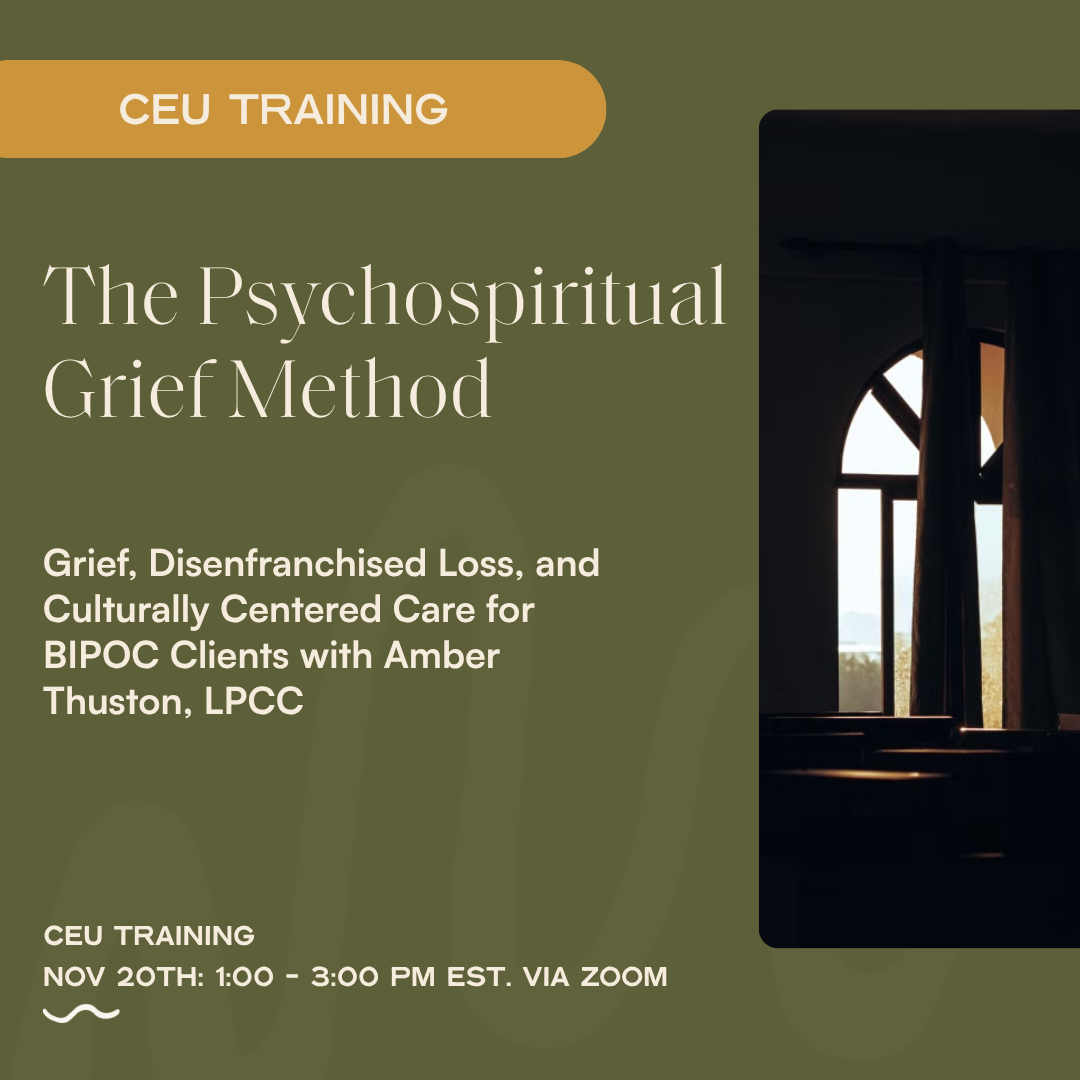
The Psychospiritual Grief Method: Grief, Disenfranchised Loss, and Culturally Centered Care for BIPOC Clients

from $89.00

Nov 20th 1:00-3:00pm EST, conducted online via Zoom

Some losses never get a name. There is no funeral, no sympathy card, and often no clinical language the field has agreed to use. This two-hour training is drawn directly from the NBCC-approved 6-hour continuing education program on BIPOC grief and gives licensed and pre-licensed mental health professionals a working clinical framework which is grounded in multicultural psychotherapy theory and practice with diverse populations (Comas-Díaz & Hall, 2019) for the losses that go unnamed in session. These losses are known as disenfranchised grief and ambiguous loss, and they surface for BIPOC clients through racial grief, intergenerational loss, ritual disruption, and ancestral grief.

Participants will walk away with:

  • A differentiated clinical vocabulary for grief typologies, built on established grief counseling and grief therapy models (Worden, 2018)

  • A culturally responsive assessment approach that screens specifically for disenfranchised loss, ritual disruption, and ancestral grief

  • Concrete clinical language for naming racial grief and intergenerational loss directly with clients, informed by a family-systems view of how loss and identity move across individual, family, and social life-cycle stages (McGoldrick, Garcia-Preto, & Carter, 2016). The vocabulary is grounded in applied case formulation through composite vignettes representing BIPOC communities. Participants will also be introduced to the Psychospiritual Grief Method's five-phase ARISE framework (Acknowledge, Embody, Reconnect, Integrate, and Transform) as a clinical tool they can use immediately to hold the full complexity of BIPOC grief clinically, culturally, and spiritually.

Learning Objectives:

  • Differentiate among the primary grief typologies covered in this training including anticipatory grief, prolonged grief disorder, ambiguous loss, disenfranchised grief, secondary loss, and collective and communal grief and apply the appropriate clinical framework to case presentations involving BIPOC clients whose losses are shaped by racial, ancestral, and cultural contexts.

  • Analyze the mechanisms of disenfranchised grief across three dimensions which are unrecognized relationships, unrecognized losses, and unrecognized grievers. Additionally, participants will be able to assess how systemic, racial, and cultural factors compound grief disenfranchisement in BIPOC communities, including ritual disruption, racial grief, and religious deconstruction.

  • Apply the Psychospiritual Grief Method's five-phase clinical framework: Acknowledge, Reconnect, Integrate, Sustain, and Embody to structure grief work with BIPOC clients, integrating somatic awareness, ancestral and spiritual dimensions, and culturally centered care across West African diaspora, Latinx, and Asian grief frameworks.

  • Demonstrate cultural humility in grief assessment and intervention by identifying their own cultural assumptions and training gaps, formulating culturally responsive clinical responses to composite BIPOC case vignettes, and articulating at least one concrete step toward ongoing professional development in psychospiritual and culturally centered grief practice.

Cultivating Healers seeks to provide educational and engaging CEUs with liberatory information, pop-quizzes, and case studies to ensure your learning.

This training is eligible for 2 Continuing Education Credits for NBCC Counselors & NY LMHCs, NY LCSWs, NY LMSWs, NY LMFTs, NY LCATs, and ATCB Art Therapists. Cultivating Healers is approved by the American Psychological Association (APA) to sponsor continuing education for psychologists.

Rate Type:

Nov 20th 1:00-3:00pm EST, conducted online via Zoom

Some losses never get a name. There is no funeral, no sympathy card, and often no clinical language the field has agreed to use. This two-hour training is drawn directly from the NBCC-approved 6-hour continuing education program on BIPOC grief and gives licensed and pre-licensed mental health professionals a working clinical framework which is grounded in multicultural psychotherapy theory and practice with diverse populations (Comas-Díaz & Hall, 2019) for the losses that go unnamed in session. These losses are known as disenfranchised grief and ambiguous loss, and they surface for BIPOC clients through racial grief, intergenerational loss, ritual disruption, and ancestral grief.

Participants will walk away with:

  • A differentiated clinical vocabulary for grief typologies, built on established grief counseling and grief therapy models (Worden, 2018)

  • A culturally responsive assessment approach that screens specifically for disenfranchised loss, ritual disruption, and ancestral grief

  • Concrete clinical language for naming racial grief and intergenerational loss directly with clients, informed by a family-systems view of how loss and identity move across individual, family, and social life-cycle stages (McGoldrick, Garcia-Preto, & Carter, 2016). The vocabulary is grounded in applied case formulation through composite vignettes representing BIPOC communities. Participants will also be introduced to the Psychospiritual Grief Method's five-phase ARISE framework (Acknowledge, Embody, Reconnect, Integrate, and Transform) as a clinical tool they can use immediately to hold the full complexity of BIPOC grief clinically, culturally, and spiritually.

Learning Objectives:

  • Differentiate among the primary grief typologies covered in this training including anticipatory grief, prolonged grief disorder, ambiguous loss, disenfranchised grief, secondary loss, and collective and communal grief and apply the appropriate clinical framework to case presentations involving BIPOC clients whose losses are shaped by racial, ancestral, and cultural contexts.

  • Analyze the mechanisms of disenfranchised grief across three dimensions which are unrecognized relationships, unrecognized losses, and unrecognized grievers. Additionally, participants will be able to assess how systemic, racial, and cultural factors compound grief disenfranchisement in BIPOC communities, including ritual disruption, racial grief, and religious deconstruction.

  • Apply the Psychospiritual Grief Method's five-phase clinical framework: Acknowledge, Reconnect, Integrate, Sustain, and Embody to structure grief work with BIPOC clients, integrating somatic awareness, ancestral and spiritual dimensions, and culturally centered care across West African diaspora, Latinx, and Asian grief frameworks.

  • Demonstrate cultural humility in grief assessment and intervention by identifying their own cultural assumptions and training gaps, formulating culturally responsive clinical responses to composite BIPOC case vignettes, and articulating at least one concrete step toward ongoing professional development in psychospiritual and culturally centered grief practice.

Cultivating Healers seeks to provide educational and engaging CEUs with liberatory information, pop-quizzes, and case studies to ensure your learning.

This training is eligible for 2 Continuing Education Credits for NBCC Counselors & NY LMHCs, NY LCSWs, NY LMSWs, NY LMFTs, NY LCATs, and ATCB Art Therapists. Cultivating Healers is approved by the American Psychological Association (APA) to sponsor continuing education for psychologists.