April 17th 1:00-3:00pm EST, conducted online via Zoom
S.E.X! Whew—did you notice that?
Sometimes, when we think or talk about sex, we feel the tabooness of our thoughts and the audacity of our conversation. Sex is ubiquitous. It’s used to sell everything. It’s everywhere. And, for the most part, it’s how everyone got here.
Yet, for many of us, our training, supervision, and overall comfort with discussing sex(uality) are limited. That isn’t necessarily a problem—until clients are involved. Our lack of discussion can lead clients to believe that sex is simply not important enough to bring into the therapeutic setting (Love & Farber, 2017).
Or worse, therapists without requisite training—but with strong personal beliefs—can erroneously push ideas of what is “normal” onto clients, further alienating how clients experience and discuss their sex(uality) (Wilson, 2019).
Not to mention that, like much in the field of mental health, any training or supervision we have received on sex(uality) is often hella focused on the white male experience. This creates additional challenges in bridging the space between sexual and cultural competence (Love & Farber, 2017; Vidal-Ortiz, Robinson, & Khan, 2018). So, not only is it important to learn about sex(uality) in general, but it is equally important to learn more about Black women’s sex(uality) specifically, so we can do right by our clients (Thorpe et al., 2022).
In this training, participants will explore why it’s critical for clinicians to know more about Black women’s sex(uality) as it relates to clients’ overall well-being. We will also examine our own “stuff” that may be serving as a barrier between us and the conversations our clients actually require. You don’t want to miss this one!
Learning Objectives:
Identify 3 reasons why it is important to include sex and sexuality in conversation with clients, especially for Black women
Identify 2 barriers that may limit discussions about sex and sexuality in clinical work.
Learn 1 technique for integrating discussions of sex and sexuality into therapy with Black women.
Cultivating Healers seeks to provide educational and engaging CEUs with liberatory information, pop-quizzes, and case studies to ensure your learning.
This training is eligible for 2 Continuing Education Credits for NBCC Counselors & NY LMHCs, LCSWs, and LMSWs. Cultivating Healers is approved by the American Psychological Association (APA) to sponsor continuing education for psychologists.
Want to seek your company’s financial support? Check out our request template to make the ask, and sign up using the organizational rate.
April 17th 1:00-3:00pm EST, conducted online via Zoom
S.E.X! Whew—did you notice that?
Sometimes, when we think or talk about sex, we feel the tabooness of our thoughts and the audacity of our conversation. Sex is ubiquitous. It’s used to sell everything. It’s everywhere. And, for the most part, it’s how everyone got here.
Yet, for many of us, our training, supervision, and overall comfort with discussing sex(uality) are limited. That isn’t necessarily a problem—until clients are involved. Our lack of discussion can lead clients to believe that sex is simply not important enough to bring into the therapeutic setting (Love & Farber, 2017).
Or worse, therapists without requisite training—but with strong personal beliefs—can erroneously push ideas of what is “normal” onto clients, further alienating how clients experience and discuss their sex(uality) (Wilson, 2019).
Not to mention that, like much in the field of mental health, any training or supervision we have received on sex(uality) is often hella focused on the white male experience. This creates additional challenges in bridging the space between sexual and cultural competence (Love & Farber, 2017; Vidal-Ortiz, Robinson, & Khan, 2018). So, not only is it important to learn about sex(uality) in general, but it is equally important to learn more about Black women’s sex(uality) specifically, so we can do right by our clients (Thorpe et al., 2022).
In this training, participants will explore why it’s critical for clinicians to know more about Black women’s sex(uality) as it relates to clients’ overall well-being. We will also examine our own “stuff” that may be serving as a barrier between us and the conversations our clients actually require. You don’t want to miss this one!
Learning Objectives:
Identify 3 reasons why it is important to include sex and sexuality in conversation with clients, especially for Black women
Identify 2 barriers that may limit discussions about sex and sexuality in clinical work.
Learn 1 technique for integrating discussions of sex and sexuality into therapy with Black women.
Cultivating Healers seeks to provide educational and engaging CEUs with liberatory information, pop-quizzes, and case studies to ensure your learning.
This training is eligible for 2 Continuing Education Credits for NBCC Counselors & NY LMHCs, LCSWs, and LMSWs. Cultivating Healers is approved by the American Psychological Association (APA) to sponsor continuing education for psychologists.
Want to seek your company’s financial support? Check out our request template to make the ask, and sign up using the organizational rate.

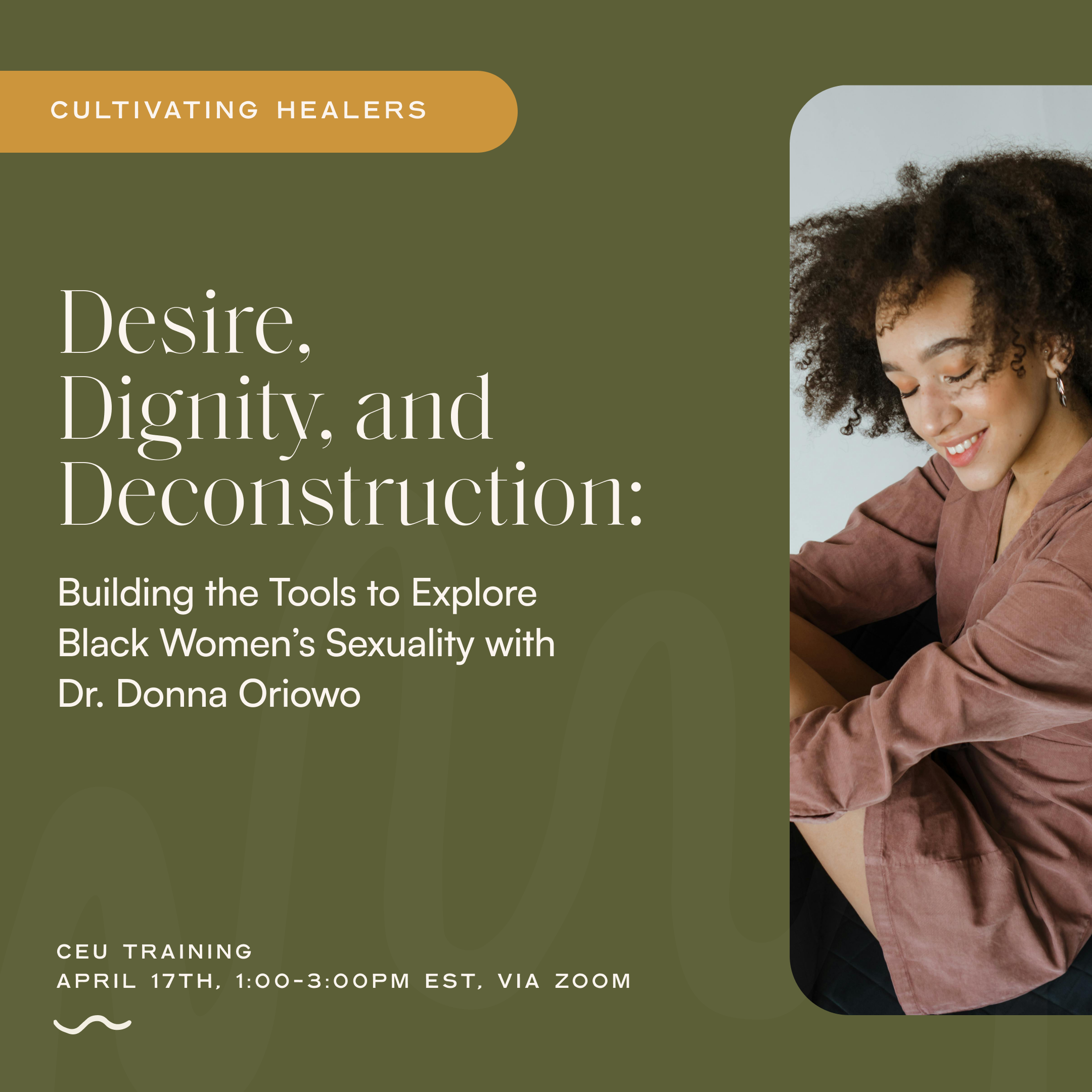 Image 1 of 2
 Image 2 of 2